Your Ultimate Guide on Picking & Pairing High-Performance Angle Modification Systems with Optimized Coilover Hardware
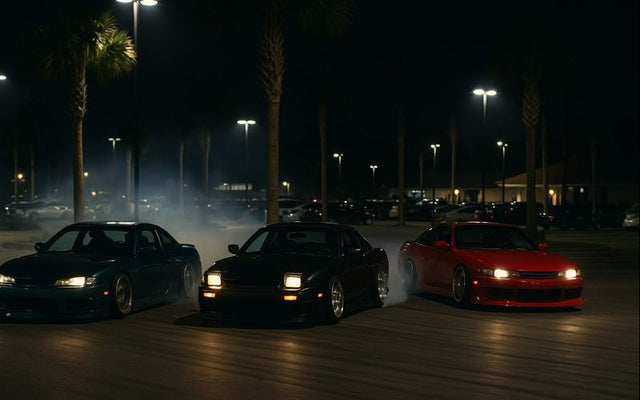
Inside the demanding arena of contemporary pro-level sliding, victory is not merely solely a result of brute engine power or driver courage. Rather, it has evolved into a complex discipline which requires a meticulous marriage of choosing a proven vehicle platform, arming it with the highest-quality drift-spec hardware, and, most importantly, grasping its dynamic performance on the track through advanced drift telemetry software. This definitive guide acts as your roadmap starting from the very first concept of a drift build through to the final data-informed tweaks that elevate a strong machine into a consistent podium finisher. We will thoroughly explore the art and science of chassis dynamics adjustment, demonstrating how a modern suspension tuning tool like a dedicated telemetry system removes approximation and provides exceptional insight into your vehicle's actual behavior.
The cornerstone of any successful competitive sliding vehicle is, without question, the platform itself. A select group of cars have attained renowned reputation within the international oversteer culture due to their built-in balance, strong construction, and the enormous availability of performance parts available. Selecting the right platform is the primary and most important selection a enthusiast will make. For instance, the BMW E36 is widely regarded as one of the greatest overall drift cars of the modern era. Its almost ideal balanced front-to-rear weight, coupled with a driven rear axle configuration and bulletproof six-cylinder motors, creates a car that is simultaneously forgiving for newcomers and highly capable in the possession of a expert driver. The evolution of this lineage, the BMW E46, improves on these attributes with a increasingly developed frame, wider track for enhanced high-speed stability, and yet more steering angle as standard from the manufacturer. A distinct powerful platform in the top-level circuit is the C6 generation Corvette.
This muscle-derived track weapon introduces a particular array of benefits to the sideways world, such as a low-mass alloy chassis, a transaxle-style drivetrain component that contributes to an excellent front-to-rear mass ratio, and the tremendous thrust of a large-displacement LS V8 motor. This blend transforms it into an absolute force on track, capable of initiating and maintaining long slides with apparently minimal application of throttle. For those seeking exceptional performance per dollar, the 350Z model Nissan excels as a prime candidate. It comes from the manufacturer with a rigid platform, a competent factory limited-slip differential, and the free-revving VQ35DE engine that provides ample power and torque for learning and moving up in the discipline. Its follow-up, the 370Z model, presents additional advancements in body strength, handling precision, and peak powerplant output, solidifying its status as a popular pick among competitive pilots. Other iconic vehicles that merit mention encompass the lightweight unique Mazda FC, the ubiquitous Nissan S13 240SX, the American Ford Mustang SN95, the more recent BMW E90, and the small yet unbelievably playful and instructive Mazda MX-5. Every single one of these chassis gives a unique set of characteristics, challenges, and potentials, but they all share the basic ingredients essential to serve as a competitive sliding vehicle.
However, picking the right chassis is merely the first step. To release the true performance of any of these vehicles, significant upgrades to the steering and chassis control systems are completely non-negotiable. This is where the domain of performance drift-spec hardware becomes critical focus. The single most impactful modification for a purpose-built drift machine is the installation of a high-performance drift angle kit. These engineered kits, such as those engineered by industry leaders like specialist manufacturers, are created to significantly enhance the car's available turning lock. A standard production vehicle is severely limited in how far its steering tires can pivot, a safety compromise for public road driving. In sliding, however, extreme opposite lock is constantly required to control and sustain a slide. An steering kit substitutes the OEM uprights, linkages, and often control arms with components that permit the wheels to reach steering lock in excess of 70 or even 80 degrees, versus a typical OEM setting of around 40 to 50 degs.
This vastly expanded steering angle provides the operator with dramatically greater command during a slide, allowing it to be far more straightforward to initiate a oversteer moment, sustain it through a sweeping corner, and transition smoothly from one angle to the opposite. The improvement in controllability is nothing short of transformative. Coupled with a correctly chosen angle kit is the just as critical modification to the vehicle's spring and damper setup. Store-bought or even premium road dampers are simply not intended for the specific and harsh requirements of competitive oversteer. A purpose-built system of suspension units is of utmost importance. These engineered coilovers feature specific valving and spring stiffness that are designed for the extreme load shifting that is typical of drifting. When a pilot begins a drift, the vehicle's weight is transferred rapidly to the front of the corner. Optimal competition suspension manage this shift in a controllable way, permitting the chassis to settle rapidly and providing the operator clear feedback through the wheel and driver's seat. They furthermore allow for precise tuning of stance, damping stiffness, and corner weighting, which are all integral parts of dialing in the car's dynamics to a given venue or competition style. Together, a high-quality steering angle kit and a correctly selected system of competition suspension units are the core hardware cornerstone upon which all future refinement is based.
Once the essential parts is fitted, the following vital stage in the project is the precise tuning of the car's suspension geometry. This is the world of chassis dynamics adjustment, a methodology that can feel overwhelmingly complex to the beginner but is, in fact, the secret to turning a set of capable parts into a cohesive and consistent vehicle. The most debated parameter of tuning for oversteer is definitely camber. Camber is the angle of the wheel relative to the upright plane when observed from the front-on of the car. When the upper part of the wheel is leaning towards the chassis, this is referred to as inward tilt. In oversteer driving, negative camber on the front tires is widely used and is regarded as critical. The purpose is fundamentally tied to vehicle dynamics.
When a chassis is going around a bend at extreme angles, the chassis leans to the external of the bend. This body roll causes the outside steering tire to reduce its ideal grip area with the asphalt. By introducing an inward tilt, the wheel is pre-leaned to account for this roll. As the car leans into the corner, the outside front tire flattens out on the track, optimizing its grip at the exact point when it is needed most for steering authority. Commonly, front axle camber settings for a serious sliding vehicle fall between approximately -3 degrees to as much as -5 degrees or even greater, contingent on the parameters of the chassis setup, rubber type, and operator preference. The back wheels also utilize inward tilt, but the settings are generally more modest and subtler than the front. Excessive negative camber at the back can result in the chassis excessively loose and hard to manage on throttle application, as it reduces the usable contact patch of the driven tires during straight-line throttle application. Therefore, rear camber settings are often in the vicinity of -1 degree to -3 degrees, striking a careful balance between offering sufficient cornering bite to assist in entering and sustaining the slide while still maintaining good grip for acceleration the bend. camber angle is just one part of the more complex tuning puzzle, which furthermore includes toe setting, caster, and bump steer adjustment.
Toe setting is the angle of the wheels when looked at from above. Inward toe means the front edges of the wheels are nearer together than the trailing edges, while negative toe means the reverse. For oversteer, a small amount of front axle toe-out is commonly run to quicken the initial handling response, making the vehicle feel more agile and eager to begin a drift. Rear axle toe angle is generally set to zero or a very slight amount of toe-in to foster stability under throttle. Caster is the forward or aft tilt of the suspension pivot when viewed from the side of the vehicle. Positive caster increases feedback and high-speed stability, and it furthermore increases camber increase during turning, which is extremely useful. Adjusting these values is a intricate dance where a adjustment to one parameter can and often will affect the remaining parameters. The old-school process for setting a chassis's alignment for drifting has historically been a tedious process of trial and error. A tuner or crew would apply a change based on experience, run the vehicle on track, rely on the pilot's individual feel and feedback, and then make a further change. This cycle would repeat time after time until the car felt "good" or the allotted practice time was exhausted. This methodology is not just exceptionally inefficient in terms of time and tires, fuel, and parts, but it is additionally fundamentally inaccurate.
Pilot feel is a notoriously subjective data source, colored by many elements such as fatigue, changing track grip levels, temperature, and simply the focus of the operator on that given session. What feels "tail-happy" on one lap might feel "understeery" on the subsequent pass, leading to conflicting data and frustrating adjustments. This age-old problem in vehicle dynamics optimization is precisely where contemporary technology has intervened to transform the methodology.
The rise and application of sophisticated drift telemetry software has ushered in a completely new age for building and optimizing high-performance drift cars. This new generation of systems, represented by innovative products like data acquisition tools, work by actively capturing the actual mechanical performance of the car as it is being driven on the course. Unlike depending on personal feedback, these tools collect measurable metrics on key variables such as suspension travel, individual tire rotation, acceleration forces, steering angle, and accelerator and brake pedal input. This acquired data stream is then processed by advanced algorithms that can plot and decode the information in a clear manner. For the very first time, engineers and crews can visualize specifically what the chassis is doing at every millisecond of a drift. This capability changes the whole alignment optimization procedure. Consider the specific challenge of optimizing the front camber for a specific chassis. Rather than applying a adjustment from -3 degrees to -3.5 degrees and then testing several laps to try and "perceive" a improvement, a telemetry system can give real-time and definitive information. The tool can indicate in a chart how the wheel's loading is acting during the key moments of a slide: turn-in, sustain, and switch. It can demonstrate if the current camber setting is allowing the loaded tire to achieve ideal grip or if the rubber is over-stressed on its outside edge.
The system can after analysis suggest empirical suggestions for adjustment. Perhaps the information reveals that the outside front tire is still overloading its sidewall at -3.5 degrees of negative camber, suggesting that even more angle, say -4 degrees, might be advantageous. On the other hand, the data might reveal that the tire is not achieving optimal operating suspension tuning tool temp or that the inner edge is degrading excessively, which could point to that there is overly aggressive inward lean and a slight lessening back to -3.2 degrees would be better optimal. This standard of accuracy and actionable analysis was simply impossible in the days of pure seat-of-the-pants setup.
The benefit of employing a advanced vehicle dynamics tool reaches well beyond merely dialing in camber. It functions as an invaluable damper adjustment manual that is customized to your particular vehicle. When adjusting the rebound and compression settings on your adjustable dampers, instead of depending on vague tips or copying another team's setup, you can utilize the software to observe how the vehicle is behaving in reaction to your adjustments. The tool can show the damper movement data over a run, highlighting if the dampers are managing the weight transfer properly or if they are causing the car to oscillate excessively after a direction change. It can aid in identifying challenges like bottoming out or losing droop, permitting you to make educated adjustments to spring preload, rebound/compression values, or ride height. This methodology extends equally to the complex process of corner balancing. Beyond camber, the tool can offer insight into how changes to toe and caster angle are influencing the vehicle's stability during various parts of a lap. For example, it can help you to ascertain the ideal amount of front axle negative toe for your specific steering configuration and piloting approach by showing the response time of initial response and the stability of the car at maximum countersteer. This makes the system an incredibly effective performance optimization handbook that is constantly calibrated by the live dynamics of your own car on the track. It moves suspension tuning tool the entire endeavor from a dark art into a repeatable engineering exercise.
Furthermore, the utility of a system like GripDial is not limited to experienced teams with vast budgets. For the grassroots competitor, it functions as an powerful educational tool. It in essence offers the driver with the knowledge of a full-time dynamics engineer without needing the associated expense. It speeds up the tuning process by delivering definitive directions to challenges that would normally take seasons of experience to understand. A driver can learn how their specific chassis behaves to specific settings, gaining a more intuitive knowledge of suspension theory in the endeavor. It additionally makes accessible advanced chassis dynamics concepts, allowing anyone with the ambition to perfect their vehicle to achieve it in a structured and effective manner. This is notably significant in a discipline like sliding, where setup expertise has in the past been a tightly held asset among top crews. In the modern era, that capability can be in the hands of any motivated driver.
In conclusion, the journey to constructing and tuning the ideal high-performance sliding vehicle is a multi-faceted project that smoothly integrates classic mechanical principles with 21st-century telemetry tools. It starts with the strategic selection of a legendary car, then enhanced by the integration of essential performance components like drift-spec angle modification systems and correctly specified drift-spec suspension units. The build then progresses into the detailed drift telemetry software stage of chassis dynamics adjustment, where settings like camber, toe setting, and caster are meticulously configured to suit the vehicle's new hardware and the pilot's personal technique. Finally, and what really distinguishes the modern process from the old ways, is the use of a advanced suspension tuning application. This system eliminates the uncertainty and trial and error of solely seat-of-the-pants tuning by giving objective, live information on how the vehicle is truly performing. It serves as an indispensable suspension tuning tool, a definitive drift suspension tuning guide, and a comprehensive chassis development system. Together, this integrated methodology guarantees that all aspect of the drift car—from the pick of the chassis to the last click on the damper—is perfected for maximum competitiveness on the circuit. It embodies the full maturation of the discipline of oversteer driving, bridging raw pilot talent with surgical chassis dynamics to forge the ultimate competitive machines possible.